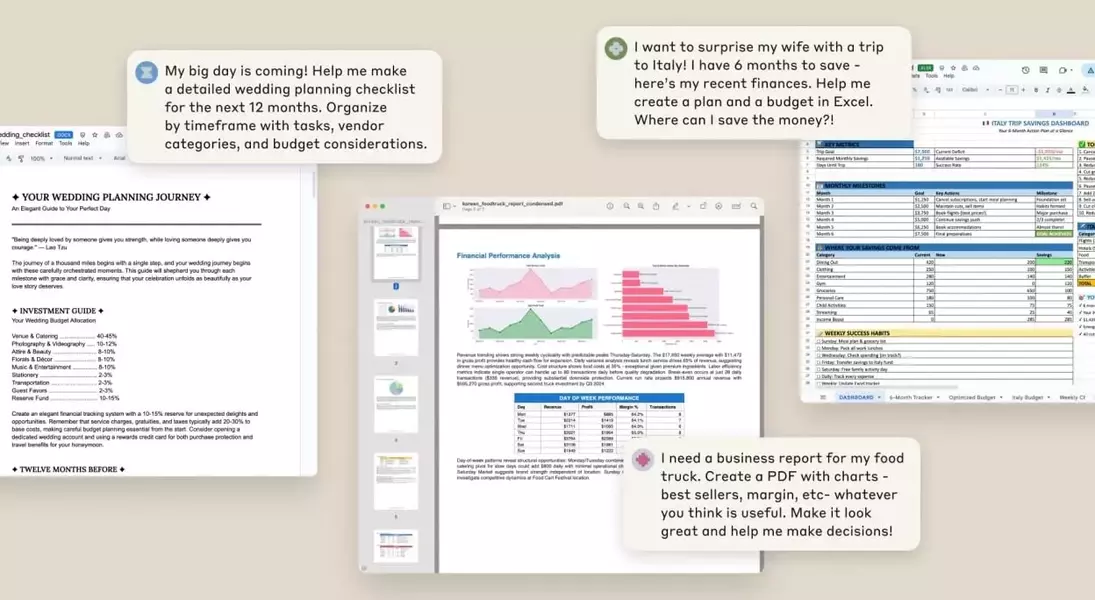
Anthropic's Claude artificial intelligence model has unveiled a significant enhancement, empowering users to automate the creation of various file types directly within their chat conversations. This innovative capability, which includes generating Excel spreadsheets, PowerPoint presentations, Word documents, and PDF files, represents a leap forward in how AI tools can directly contribute to professional and personal productivity. Initially rolled out as a preview for Claude Max, Team, and Enterprise subscribers, this feature is slated for broader availability to Claude Pro users in the near future, promising to revolutionize tedious data processing and document creation tasks.
This new functionality is a prime example of 'agentic AI' in action, a concept gaining considerable traction within the artificial intelligence community. Agentic AI refers to models equipped with advanced reasoning abilities that can dissect complex, multi-step operations and, when integrated with external software and applications, execute tasks beyond their initial programmatic limits. Anthropic's implementation grants Claude access to a secure, private computing environment, enabling it to write and execute code, thereby producing the necessary files and performing analyses as requested by the user. This strategic integration streamlines workflows, allowing the AI to handle the nuances of file structuring and content population with remarkable efficiency.
The move by Anthropic places Claude in direct competition with other leading AI models that have also ventured into agentic capabilities. OpenAI's ChatGPT, for instance, offers a similar agentic feature that can navigate the web and compile reports by accessing calendars and various user files. Google's Project Mariner is another prototype exploring agentic web browsing, while AI-powered browsers such as Arc Dia and Perplexity Comet have demonstrated abilities to manage shopping tasks and add items to virtual carts. However, Anthropic's approach focuses on a more direct and intuitive file generation process, where users provide data or instructions, and Claude synthesizes them into the desired document format. A notable parallel can be drawn with tools like Shortcut AI, which excels at replicating Excel functionalities and automating data entry through a sidebar chatbot. Claude's new feature allows for diverse applications, from generating financial models from raw data to converting PDFs into PowerPoints, or even crafting comprehensive reports complete with visual charts and analytical text.
Users keen to explore this feature can activate it through Claude's settings by navigating to 'Features', then 'Experimental', and finally enabling the 'Upgraded file creation and analysis' toggle. Once activated, Claude is ready to commence file generation based on uploaded documents or explicit text prompts. It is crucial for users to exercise caution regarding the sensitive information they share with any chatbot, including Claude. Anthropic has recently updated its terms of use, indicating that conversations may be utilized for model training unless users actively opt out. Users have a specific timeframe to opt out by adjusting their privacy settings and deactivating the 'Help improve Claude' option, emphasizing the importance of user awareness and control over their data in the evolving landscape of AI interactions.
This development significantly broadens the scope of what AI can achieve in practical, day-to-day operations, moving beyond simple conversational interfaces to proactive content generation. By enabling direct file manipulation and creation, Claude transforms into an even more indispensable tool for professionals and organizations, promising to save countless hours of manual effort. The integration of such agentic capabilities signals a future where AI assists not just with information processing but also with the tangible production of work, pushing the boundaries of automated assistance and intelligent task execution.
