
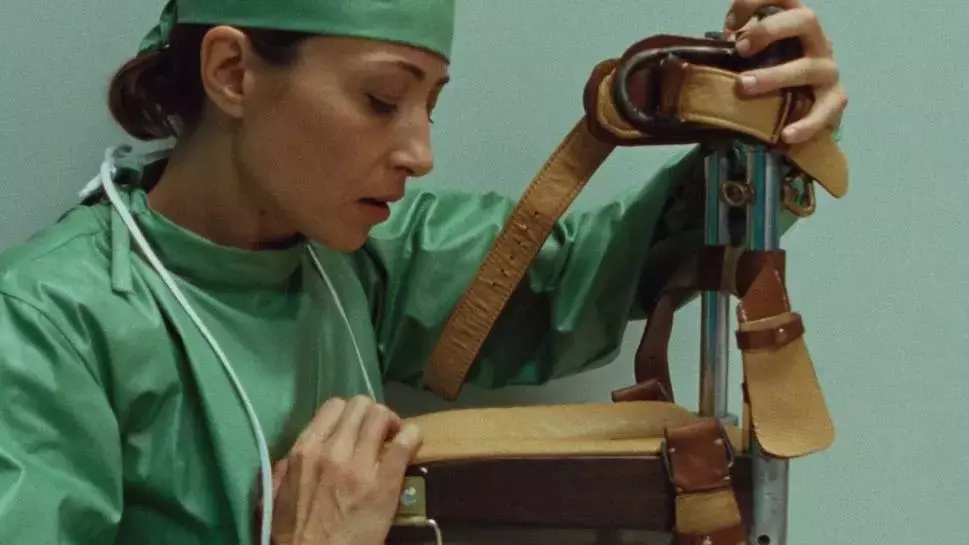
Ann Oren's latest cinematic endeavor, 'Objet a,' is set to premiere at the Locarno Film Festival, promising a profound exploration of human desire and control in an increasingly digital world. The film, starring Aenne Schwarz and Louis Hofmann, delves into the intricate relationships between people and their interactions with objects, prompting audiences to reflect on contemporary societal conditions. Oren's unique directorial vision, coupled with the actors' immersive performances, crafts a narrative that is both visceral and thought-provoking. The film uses physical expression and subtle interactions to convey deep emotional states, making it a compelling piece of modern cinema.
The creative team behind 'Objet a' discusses the film's underlying inspirations, including Jacques Lacan's psychoanalytic concept of the 'objet a,' representing an unattainable object of desire. They also touch upon the evolving nature of human connection in an age dominated by screens, where physical touch becomes a rare and potent force. The actors describe their process as a delicate balance of physical choreography and psychological depth, portraying characters driven by an intense longing that manifests in unusual ways. The film's meticulous visual style, characterized by a restrained color palette that gradually introduces vibrant green, further enhances its thematic richness, treating objects and characters with equal significance in the storytelling.
The Intricate Dance of Desire and Control
Ann Oren's new film, 'Objet a,' offers a compelling exploration of human desire and control through the story of Ingeborg and Adam, visionary hand surgeons whose lives are meticulously choreographed by their shared passions and fixations. Ingeborg's kleptomania and Adam's aspiration to become a desired object frame their unique emotional landscape. The arrival of the enigmatic Gaia disrupts their carefully balanced existence, unleashing unexpected desires and challenging their perceptions of intimacy and identity. Oren's direction, characterized by a visceral and body-driven approach, transforms the narrative into a stylized cinematic dance, where subtle gestures and unspoken tensions convey profound emotional complexities.
The creative process behind 'Objet a' involved a deep immersion into the film's thematic core, with director Ann Oren guiding actors Aenne Schwarz and Louis Hofmann through a physically expressive and psychologically rich portrayal of their characters. The film's choreography emphasizes the delicate balance between proximity and distance, highlighting the omnipresent longing for connection in a world where tactile experiences are often mediated by technology. The deliberate use of objects, such as Ingeborg's crutch and Adam's corset, serves as a powerful metaphor for extended parts of the self, further blurring the lines between human and inanimate. This nuanced approach allows the film to resonate with viewers on a physical and emotional level, inviting them to contemplate the complexities of desire and control in their own lives.
Human Connection in a Digital Age
Ann Oren's 'Objet a' critically examines the erosion of genuine human connection in an era dominated by digital interfaces, where flat screens increasingly replace intimate physical touch. The film portrays Ingeborg and Adam's relationship as a metaphor for this contemporary condition, highlighting how their emotional communication often channels through objects rather than direct physical interaction. Oren conceptualizes desire as a fundamental human drive that, when unfulfilled in its natural expression, seeks alternative outlets, often leading to obsessive behaviors and an over-reliance on material things. The film's thematic undercurrent suggests that society's attempts to control every aspect of life, including emotions and physical interactions, ultimately lead to a profound disconnect from our inherent human nature and the broader natural world.
The narrative of 'Objet a' extends beyond individual relationships to touch upon broader societal issues, such as the implications of living in a "bubbled" existence characterized by an excessive focus on control and self-preservation. Oren argues that this contemporary condition contributes to a detachment from fundamental human experiences, leading to a spiritual and emotional void. The film subtly critiques this modern predicament, presenting a fantastical yet deeply resonant story that prompts introspection on the current global landscape of conflict, environmental crisis, and technological advancements. By depicting characters who initially attempt to control passion and suppress raw emotions, only to eventually embrace an almost ecstatic release, 'Objet a' challenges audiences to consider the true cost of an over-controlled existence and the innate human need for connection, vulnerability, and genuine experience.
