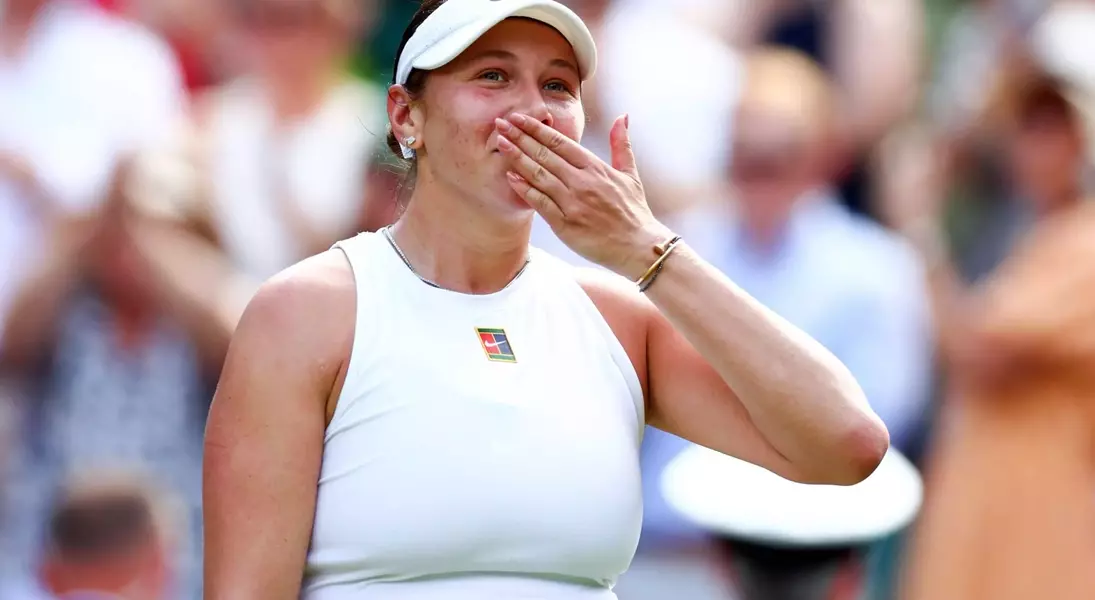
In a captivating semifinal encounter at Wimbledon, Amanda Anisimova showcased remarkable prowess to overcome Aryna Sabalenka in three sets, earning her a spot in a Grand Slam final for the first time. This significant achievement not only marks a pivotal moment in Anisimova's career but also highlights her burgeoning status in the sport. The match unfolded with intense rallies and shifts in momentum, ultimately culminating in Anisimova's triumph, signaling a fresh challenge to the established order of women's tennis. Her victory against a top-ranked opponent underscores her potential and sets the stage for an exciting final.
Sabalenka, a formidable force in recent Grand Slam events, demonstrated her customary fighting spirit throughout the contest. Despite her previous successes in reaching multiple major finals, she was unable to quell Anisimova's relentless pursuit of victory. The match statistics revealed a closely contested battle, with both players exhibiting strengths and vulnerabilities. Anisimova's composure under pressure, particularly in critical moments, played a crucial role in navigating the challenging semifinal environment and securing her place in the coveted championship match.
Anisimova's Road to the Final
Amanda Anisimova secured a monumental victory in the Wimbledon semifinals, defeating Aryna Sabalenka in a gripping three-set match with scores of 6-4, 4-6, 6-4. This triumph not only propels the American into her maiden Grand Slam final but also signifies her first-ever victory against a World No. 1 ranked player. The intensity of the match was palpable from the outset, with both athletes exhibiting strong serves and resilient returns. Anisimova's ability to capitalize on crucial moments, coupled with her unwavering determination, ultimately paved her way to the championship round. This achievement is a testament to her consistent improvement and growing confidence on the major stage, positioning her as a formidable contender for the title.
The opening set saw both players holding their service games with relative ease, setting the tone for a tightly contested match. Anisimova faced and saved break points at 3-2, showcasing her mental toughness. A pause in play due to a spectator's health issue briefly interrupted the flow, but upon resumption, the match continued its high-stakes trajectory. The turning point in the first set came at 5-4, where Anisimova secured the break after an extended, deuce-filled game, ultimately winning it 6-4. Her impressive 82% first-serve points won percentage in the first set highlighted her serving efficiency. As the second set began, both players maintained their service strength. Despite committing more unforced errors, Anisimova stayed competitive until Sabalenka found her rhythm, breaking serve and taking control. Sabalenka then secured three consecutive games, establishing a 5-3 lead and ultimately leveling the match by winning the second set 6-4, demonstrating a strong mental comeback. The decisive third set was marked by palpable tension, with both players dropping their initial service games. Anisimova, however, quickly regained her composure, securing a critical break and seizing momentum to establish a 4-1 lead. Although Sabalenka managed to hold her serve once more, Anisimova continued to press. Despite a late break back by Sabalenka, Anisimova clinched the match with a final break, sealing her most significant career victory and advancing to her first Grand Slam final. This win guarantees her a career-high ranking and offers the prospect of breaking into the top five should she claim the title.
Sabalenka's Grand Slam Aspirations
Despite a valiant effort and a display of formidable fighting spirit, Aryna Sabalenka’s quest for a Wimbledon title ended in the semifinals. The Belarusian, who had been a consistent presence in recent Grand Slam finals, once again found herself unable to cross the final hurdle. Her strong performances in previous major tournaments, reaching three consecutive Grand Slam finals and five in her last six appearances, underscore her elite status in women's tennis. However, Anisimova's exceptional play on the day proved too much for Sabalenka, preventing her from advancing to yet another championship match. This loss marks a disappointing end to what had been another promising Grand Slam campaign for the talented player.
In the initial set, Sabalenka encountered early break points but skillfully defended them with strong first serves. She even created her own break opportunities in the subsequent game, though she couldn't convert them. The set's culmination saw a grueling 18-point game, eventually conceded by a double fault, allowing Anisimova to take the lead. Sabalenka's first-serve points won percentage stood at 65% in the first set, lower than her opponent's. Entering the second set, both players remained dominant on their serves. Sabalenka, despite showing some frustration, managed to turn the tide. She seized a crucial break, stringing together three consecutive games to build a commanding 5-3 lead. Although Anisimova bravely fended off four set points, Sabalenka ultimately held her serve to claim the set 6-4, demonstrating a clear mental edge and superior play in the latter part of the set. The final set began with noticeable nerves from both contenders, resulting in early service breaks. After securing an initial break, Sabalenka faltered against Anisimova's relentless consistency. The American capitalized on a tightly contested break, surging from a 0-1 deficit to a significant 4-1 lead as Sabalenka appeared increasingly desperate. Despite holding off another potential break at 4-1, Sabalenka struggled to maintain her composure. Anisimova capitalized on her opponent's wavering focus, securing the decisive break that sealed her monumental 6-4, 4-6, 6-4 victory, marking her first Grand Slam final appearance.
