
The artificial intelligence software sector is witnessing a dramatic surge in demand, promising substantial productivity enhancements across industries. This burgeoning market presents a significant opportunity for investors, with Palantir Technologies and BigBear.ai emerging as key contenders. While both companies are making strides in securing new business, a closer examination of their operational dynamics and growth trajectories reveals distinct investment profiles. This analysis delves into their respective strengths and weaknesses, ultimately providing a clear perspective on which entity currently offers a more attractive proposition for those looking to invest in the rapidly expanding AI landscape.
The expenditure on AI software and related tools has been escalating considerably, a trend fueled by the technology's potential to deliver immense productivity gains. Projections indicate that AI could unlock trillions in economic value over the long term. Palantir Technologies and BigBear.ai are two firms poised to benefit from this expansion, particularly within the generative AI software market, which is anticipated to achieve a remarkable compound annual growth rate of 36% through 2030. When faced with the decision of selecting between these two AI stocks for a portfolio, an in-depth comparison becomes essential to discern the optimal choice.
Palantir, widely recognized by research firms like Forrester and IDC as a leader in AI software platforms, has demonstrated impressive customer acquisition rates. In the second quarter of 2025, its customer base expanded by 43% year-over-year. More significantly, the efficiency gains realized through Palantir's AI solutions are fostering deeper engagements with existing clients. This has led to an increase in deal sizes, with 157 deals exceeding $1 million closed last quarter, marking a 64% increase from the previous year, surpassing overall customer growth. Examples such as Citibank reducing customer onboarding from nine days to seconds, and Fannie Mae identifying mortgage fraud in moments, underscore the tangible benefits provided by Palantir’s Artificial Intelligence Platform (AIP).
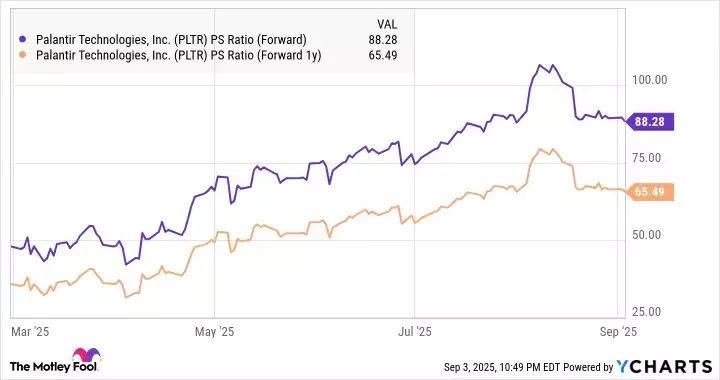
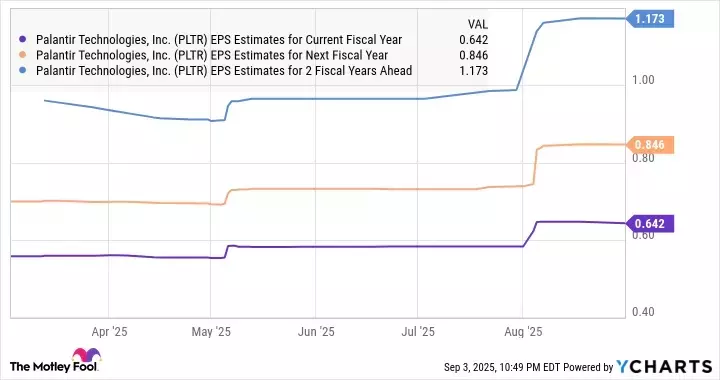
Palantir's continued ability to secure more business from its current clientele also fuels robust bottom-line expansion. Earnings are projected to surge by 57% this year to $0.64 per share, with sustained growth anticipated in the coming years. Consequently, Palantir is expected to remain a prominent AI stock, driven by the enduring growth opportunities within the AI software market. The company’s forward sales multiples are considerably lower than its trailing multiples, suggesting that its current valuation, though high, may be justified by its rapid growth and dominant position in the sector.
Conversely, BigBear.ai, which also offers AI software for enhanced decision-making, has seen its stock price more than triple over the past year. Despite this rally, its valuation appears more accessible, trading at nine times sales compared to Palantir's 115 times. BigBear.ai also boasts a growing revenue backlog, which stood at $380 million in the second quarter, representing a 43% increase from the prior year. However, a closer inspection reveals that BigBear.ai's growth trajectory is not on par with Palantir's. In Q2, its revenue declined by 18% year-over-year to $32.5 million, primarily due to delays in converting Army contracts into revenue. This dependence on government contracts makes BigBear.ai susceptible to shifts in government budgets and policies, as evidenced by its revised 2025 revenue guidance of $132.5 million, a decrease from the previous year's $158 million. Furthermore, the inherent uncertainties associated with its backlog metric suggest that a lower valuation does not necessarily translate into a superior investment.
Ultimately, for investors seeking to choose between these two AI companies, Palantir Technologies stands out as the more favorable option. Despite its demanding current valuation, Palantir’s strong market position and consistent growth rates within the dynamic AI software sector provide a compelling argument for its long-term potential. The company's demonstrated capacity to not only expand its customer base but also significantly increase its revenue per customer positions it as a leader in a sector poised for continued explosive growth.
