

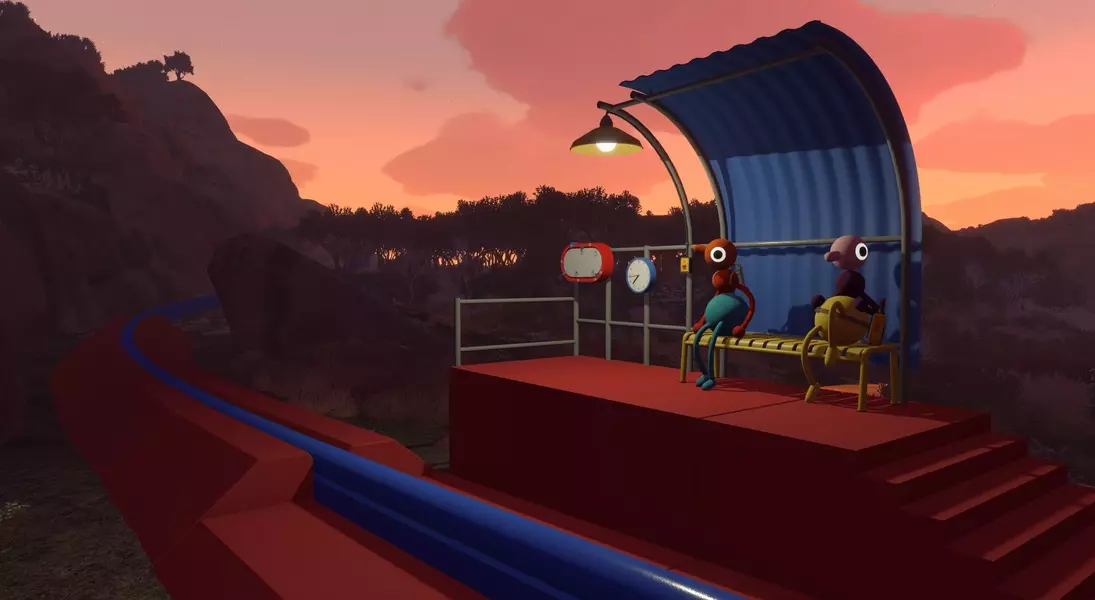
The critically acclaimed video game, Big Walk, a frontrunner for numerous accolades in 2026, finds itself at a pivotal juncture as the awards season approaches. The developer's recent admission of utilizing generative artificial intelligence in the game's creation has ignited a contentious discussion within the gaming sphere, potentially jeopardizing its prospects at major award ceremonies, including the coveted Game Awards in December. This situation transcends a mere awards season footnote; it represents the culmination of a protracted debate surrounding AI's role in the video game industry that has been escalating for years.
The "Big Walk" Controversy and its Industry-Wide Ramifications
On a significant Monday, a collective of nineteen jurors from the Independent Game Festival (IGF), featuring notable figures such as Immortality director Sam Barlow and Friends at the Table host Austin Walker, issued a declaration. They asserted their refusal to cast votes for any game that incorporated generative AI tools, even if the usage was restricted to code generation. Barlow later clarified on Bluesky that while IGF juror discussions are typically animated, this year's dialogue was exceptionally fervent.
The catalyst for this heightened intensity soon became apparent: House House, the studio behind Big Walk, voluntarily revealed its use of generative AI in the game's development process to the IGF. Barlow emphasized that the broader impetus for the discussion was the increasing prevalence of generative AI across numerous games, with Big Walk emerging as a critical case study.
In a detailed statement released to Aftermath and subsequently posted on the developer's official website, House House clarified that generative AI tools contributed to less than 0.1% of Big Walk's codebase. Their primary application was to aid in resolving intricate technical challenges and debugging. The studio further elaborated on their use of large language models (LLMs) to establish a foundational code, which was then meticulously refined by their development team. As an illustration, House House cited a lighting issue during Big Walk's final development phase, where LLMs generated approximately ten lines of code to assist in its resolution.
While this might appear to be a negligible contribution in the grand scheme of development, for a segment of the IGF jury, it represented a clear transgression of their established boundaries. The nineteen jurors articulated a multitude of reasons for their resolute stance against generative AI. These reasons encompassed the technology's well-documented adverse effects on economic structures, labor markets, environmental sustainability, and the integrity of global information dissemination. They posited that the integration of AI into the gaming industry is not an inevitable outcome and that, as independent developers, they possess a unique opportunity to adopt a firm position that larger corporations might find difficult to embrace.
Notably, the inclusion of code within their strict prohibition against generative AI marks a significant expansion of the prevailing discourse. Typically, the opposition to generative AI in creative fields like art, writing, music composition, and voice acting has been more pronounced. Technical disciplines, such as programming, have often been granted exceptions. This resolute stance from a faction of the IGF jury signals a public broadening of the scope among an influential group within the gaming industry, a development that resonates deeply with a segment of the community not always in the public eye. Programmers, in particular, have expressed their gratitude on platforms like Bluesky, acknowledging the jurors' recognition of coding as an art form.
The revelation has also sent ripples throughout the broader gaming community. The ensuing debate is not a simplistic dichotomy of pro-AI versus anti-AI sentiments. Some critics view House House's actions as a breach of trust, not only for employing these tools but also for their initial lack of disclosure. The argument posits that if the use of an LLM was inconsequential, then why conceal it? And if this instance was hidden, what other undisclosed aspects might exist? It's worth noting that while platforms like Steam mandate disclosure for generative AI in content, they do not extend this requirement to code or chatbot usage.
Conversely, others perceive this situation as the most favorable outcome for a challenging circumstance. They contend that the AI's involvement was minimal, and questioning whether the implementation of strict disclosure guidelines for ten lines of AI-generated code would unfairly disqualify numerous video games. Furthermore, they highlight House House's apparent willingness to reflect and adapt, referencing the studio's prior philanthropic endeavors as evidence of their goodwill. For instance, following the release of Untitled Goose Game in 2020, House House committed to donating one percent of its profits to organizations supporting indigenous communities with rent assistance.
The question remains whether this controversy will ultimately impact Big Walk's performance during the awards season. The statement from the IGF jurors, though originating from a smaller group, has gained considerable traction across both social and traditional media platforms. As this issue has garnered public interest and widespread discussion, there is a distinct possibility that other voters may be influenced by these arguments or become hesitant to endorse Big Walk.
The repercussions for the prestigious Game Awards are less clear. Earlier in the week, Big Walk was widely considered a strong contender for a Game of the Year nomination, according to Polygon's ongoing analysis of the competition. However, securing a GOTY nomination for an independent game is inherently an uphill battle, even without the added burden of controversy. While the independent game Clair Obscur: Expedition 33 achieved unprecedented success and dominated the 2025 Game Awards, it also garnered widespread mainstream appeal, a level of recognition that Big Walk, despite its impressive critical reception, has yet to attain. To secure a nomination, Big Walk requires every possible vote from nominating jurors, particularly those within the indie gaming community, which largely opposes generative AI. It is noteworthy that Clair Obscur, despite its triumph at the 2025 awards, had its Game of the Year award from the Indie Game Awards (distinct from the IGF) rescinded due to AI inclusion.
Beyond the realm of awards, this entire narrative appears to be a pivotal moment for an industry grappling with the escalating integration of generative AI. Developers across all tiers, from the creator of The Last of Us to the studio behind the Wendy's JRPG, have publicly declared their opposition to this technology, vowing to abstain from using AI in any aspect of their development process. Their stance contrasts sharply with that of prominent firms like Embark Studios, which faced criticism for employing AI in its 2023 shooter The Finals and subsequently utilized the same tools for its 2025 title Arc Raiders. Similarly, Epic Games, led by a CEO whose perspective on LLMs can be characterized as profoundly enthusiastic, represents another contrasting viewpoint.
Throughout this period, AI tools have consistently proven to be a highly sensitive subject for a significant portion of the gaming audience, frequently leading to public apologies from developers who disclose their use. House House now joins this growing cohort.
In their statement, House House admitted, "Big Walk was developed without an internal AI usage policy in place, and we consider that lack of policy a failure. We will work to have a more comprehensive policy going forwards."
This commitment from House House is commendable. Establishing clear and defined guidelines for such matters helps to resolve internal disagreements and provides a guiding principle for all studio employees. It could even serve as a model for other industry players to emulate. Nevertheless, the absence of a policy should not fall solely on the shoulders of a small Melbourne-based outfit, or indeed any developer, regardless of size. Generative AI tools have been publicly available for nearly half a decade. Until governments seriously address this technology and enact meaningful regulations governing acceptable use, such incidents are likely to persist.
