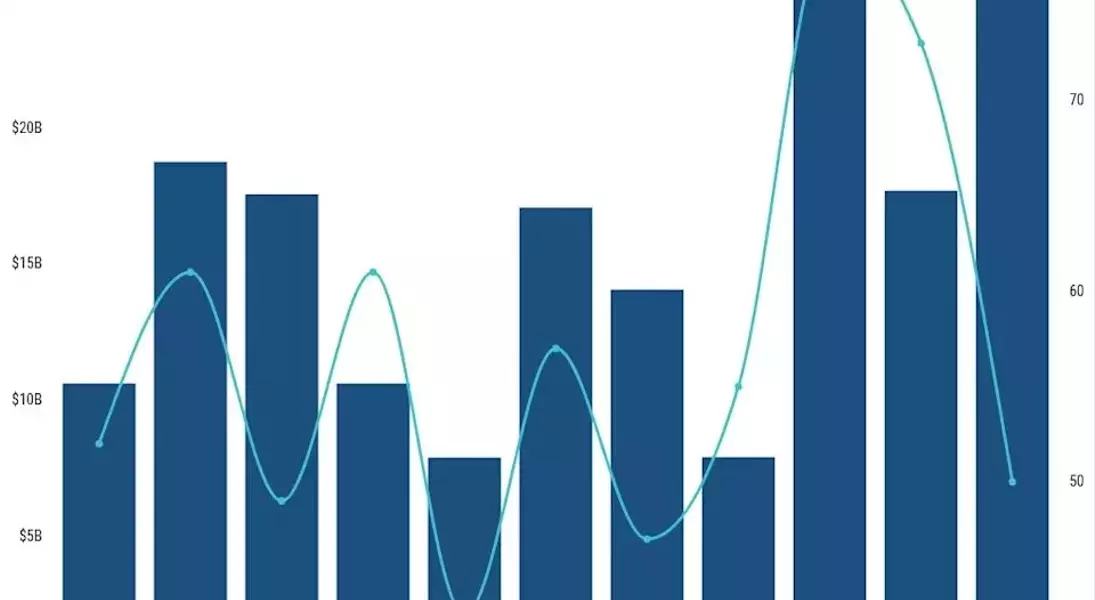

In a significant development for the financial landscape of the aerospace and defense industry, private equity-backed companies have generated an impressive $26.8 billion in exit value during the initial six months of 2026. This figure notably eclipses the $17.7 billion achieved throughout the entirety of 2025, signaling a robust and accelerating market for these investments. The surge is primarily propelled by a series of successful public listings, underscoring a dynamic shift in exit strategies compared to the previous year. This positive trend not only highlights the sector's current strength but also provides much-needed liquidity for private equity managers navigating an environment with an abundance of seasoned portfolio assets.
The remarkable increase in exit values for the aerospace and defense sector, as detailed in PitchBook's Q2 2026 Aerospace and Defense Report, represents a substantial upward trajectory. This impressive growth is largely credited to five significant public offerings that materialized in the second quarter of 2026, a stark contrast to the absence of such listings in the same period of 2025. This shift underscores a renewed investor appetite for public market exposures within this critical industry.
Among the notable initial public offerings (IPOs) driving this expansion, DPC Holdings stands out. This UK-based specialist in jet engine metal parts manufacturing went public in June, commanding a valuation of $4.9 billion. This successful listing provided a strategic exit for J.F. Lehman & Company, a New York-based private equity firm with a dedicated focus on the aerospace and defense sector. Other significant IPOs during the quarter included Global Medical Response, valued at $3.4 billion; Applied Aerospace & Defense, also debuting at $3.4 billion; and Aevex, an autonomous weapons developer, achieving a $2.2 billion exit.
Industry experts, such as Jim Corridore, lead industrials research analyst at PitchBook, attribute this heightened market activity to several factors. The recent IPO of SpaceX and ongoing geopolitical events have cast a strong spotlight on the industry. Furthermore, major players like Boeing, Lockheed Martin, and Airbus are driving demand. Specifically, the need for new aircraft to modernize aging commercial fleets is a significant catalyst, with Boeing and Airbus striving to balance increased production with the ongoing maintenance of older planes. This dynamic creates a fertile ground for private equity involvement, particularly in the aftermarket supply chain, which includes replacement parts and repair services.
Commercial aerospace companies accounted for the largest portion of the quarter's exit value from private equity-backed entities, representing 40% of the total. This highlights the sustained importance of the commercial aviation segment within the broader aerospace and defense market. The quarter also saw a total of 27 exits, marking a 17.4% increase quarter-over-quarter and a 22.7% rise year-over-year. While public listings generated the highest exit values, leveraged buyouts dominated in terms of the sheer number of exits. Despite an increase in the total deal count by 10.9% quarter-over-quarter, the overall deal value decreased from $11.1 billion to $6.5 billion, indicating a market trend towards smaller and medium-sized transactions.
The success in exiting these investments offers welcome relief for private equity firms, many of whom are managing a backlog of mature portfolio companies. PitchBook data reveals that private equity managers hold over $860 billion in buyout net asset value concentrated in funds that are seven years or older, exceeding traditional exit timeframes. The mergers and acquisitions landscape saw strategic acquirers like Lockheed Martin, General Dynamics, and Northrop Grumman leading the largest deals. Corridore notes that private equity firms are primarily targeting tier two, three, and four companies, as larger entities are often already associated with publicly traded defense contractors, limiting acquisition opportunities for PE players.
